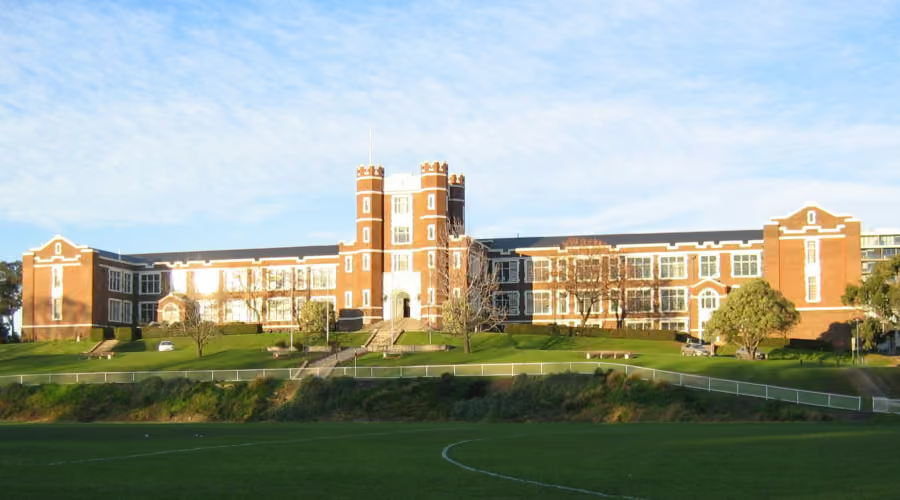
Victoria has four fully academically selective government schools: Melbourne High School, Mac.Robertson Girls' High School, Nossal High School and Suzanne Cory High School. Each admits students at Year 9 on the basis of a single entrance exam sat in Year 8. Places are limited, demand is many times supply, and for most families it is a one-time attempt. Here is how it works and how to prepare well.
The four schools in a sentence each
Melbourne High (all-boys, South Yarra) is the oldest, with a strong tradition in sport, music and leadership. Mac.Robertson Girls' (all-girls, Albert Park) is ambitious, diverse and collaborative. Nossal (co-educational, Berwick) is modern and student-centred. Suzanne Cory (co-educational, Werribee) is community-driven with a lean toward science. Families list up to four preferences on the application, so it is worth visiting and thinking about fit before the form is due.
What the exam tests
The exam is run by ACER and sat in one sitting with short breaks. There are five timed sections: Reading Reasoning, Mathematical Reasoning, Verbal General Ability, Quantitative General Ability, and Writing (two tasks). No calculators, dictionaries or aids are allowed.
The reasoning sections test how a student applies what they know to unfamiliar material. The general ability sections test speed and flexibility of thinking rather than curriculum knowledge. Writing is the section most families underestimate: ACER does not publish fixed genres, so students need adaptable creative and persuasive frameworks rather than a memorised essay.
In other words, this is not a test of how much Year 8 content a student has covered. It is a test of how they think under time pressure, which is a skill that can be trained but not crammed.
How places are decided
Students are ranked against the entire applicant pool on their overall score. There is no published pass mark; relative standing is what counts. Roughly 6,000 students sit for around 1,000 places each year, and the great majority of offers are made in the first round in late July.
Around 85 per cent of places at each school go on exam performance, with the remainder through equity consideration and principal's discretion. There is also a cap on the number of offers to students from any single school, so a student is competing primarily with the whole state rather than with their classmates.
When to start
The exam is sat in mid-June of Year 8, which means the serious preparation window is Year 7 and the first half of Year 8. Starting in Year 7 gives a student time to build reasoning skills gradually, sit several practice exams under conditions, and fix weaknesses while there is still runway. Starting in Term 1 of Year 8 is workable but compressed. Starting after Easter of Year 8 leaves very little room.
The pattern we see in students who do well is not more hours. It is earlier hours, spread out, with regular timed practice so that exam day feels like something they have done before.
The mistakes that cost places
Drilling content instead of reasoning. Finishing the Year 8 maths textbook early does not prepare a student for Quantitative General Ability. Practice needs to look like the exam.
Ignoring writing. It is one of five sections and the one with the widest spread of scores. Students who treat it as an afterthought leave marks on the table.
No exposure to real conditions. The single biggest difference on the day is familiarity. A student who has sat a full-length simulation at a real venue, with the clock running and strangers around them, walks in calm. A student whose only practice has been at the kitchen table does not.
Treating a good school report as readiness. Being top of the class at a local school is encouraging, but the exam ranks students against the strongest 6,000 in the state. A diagnostic test gives a far more useful picture than a report card.
Pressure at home. The students who perform best on the day are usually the ones who were allowed to treat it as an opportunity rather than a verdict.
Where Contour fits
Contour TestPrep runs Year 7 and Year 8 Selective Entry programs in Maths, English and Writing, taught by tutors who sat the same exam and are alumni of the schools students are aiming for. The programs include in-class mock exams roughly every six weeks with detailed reports, strategy consultations that include parents, unlimited essay feedback for Writing, and the Victorian Selective Entry Exam Simulation, a full dress rehearsal at a real venue. Every program opens with a diagnostic test and an obligation-free trial, so you will know exactly where your child stands before you decide anything.