

Read the Question, Read the Question, Read the Question!
We tend to assume or complete the meaning of sentences before we actually read them. It’s the same reason why in a particle accelerator question, you solve for the final velocity of an electron when the question was looking for kinetic energy, or you find the induced EMF from Faraday’s Law when all the question asked for was the magnetic flux through the coil. Our brains are wired to jump ahead, but we have to learn how to control them. We must be diligent and disciplined because we can’t assume what the question is asking without reading it first.
“So What Do I Do?”
I used to be a culprit myself, but I soon developed a habit to NEVER EVER start answering a question unless I’ve read it thoroughly at least 3 times (not including reading time). I would use my pen to point and read the question, so I knew I wasn’t missing any key details. And I did this every single time.
You may be wondering now, “don’t you run out of time reading the question that many times?” The answer is yes, and no. It really depends on how quickly you can COMFORTABLY read. I can comfortably read quite quickly, so I was able to easily read the questions thrice during a VCE Physics SAC or exam. You may be only able to do so once or twice, which is perfectly fine, but I highly encourage you to strive to read the question multiple times before attempting it, especially if you have sufficient time in the SAC or exam. Whatever you do, do not rush while reading. It should feel comfortable – as if you’re reading it out aloud and understand every single word.
I highly suggest you create a routine when doing questions. Mine looked something like this:
- Read Full Question Thoroughly x3
- Briefly Re-Read Question While Solving x1
- Read Full Question Thoroughly After Completion x2
It’s important you try to follow this routine until it becomes habit. Obviously, I didn’t read every question 6 times over; some questions only deserve to be read a few times (either because they’re short, easy, or you’re running out of time), and some I even read close to 10 times because I wanted to be extra sure I was securing the marks (especially for hard questions or obvious tricks in MCQ).
"Is that all - just read the question?"
Have you ever read a trick in a question only to fall for it? i.e. seeing the use of a DC battery with a transformer but still using ratios to find the secondary voltage, when it should be 0V.
Sometimes re-reading the question just isn’t enough, so what else can we do so we don’t fall for VCAA’s nasty traps?
Underline and Highlight Keywords and Phrases!
Another strategy I like to employ is underlining or highlighting. It’s so simple yet so powerful. This technique has prevented me from making hundreds of silly mistakes like the one above. Let me clarify, I’m not suggesting you underline all the keywords so you don’t forget them. There’s actually a bit more to it than that. Underlining has to be combined with reading the question multiple times as you’re placing emphasis on a phrase for when you RE-READ the question.
Imagine a mountain trail from A to B. Someone would have initially had to create the trail between A and B by trekking through the jungle, avoiding all the unsafe spots and then excavating a path and placing signs for us to follow. All we have to do is follow the path from A to B. We don’t have to put any effort in looking out for any danger as someone else has already done so for us. Same goes when underlining or highlighting the question. We’re not underlining to memorise the question. We’re underlining so that when we read the question AGAIN, the hazards in the question instantly pop out at us, as we’ve already done the hard work of identifying them beforehand.
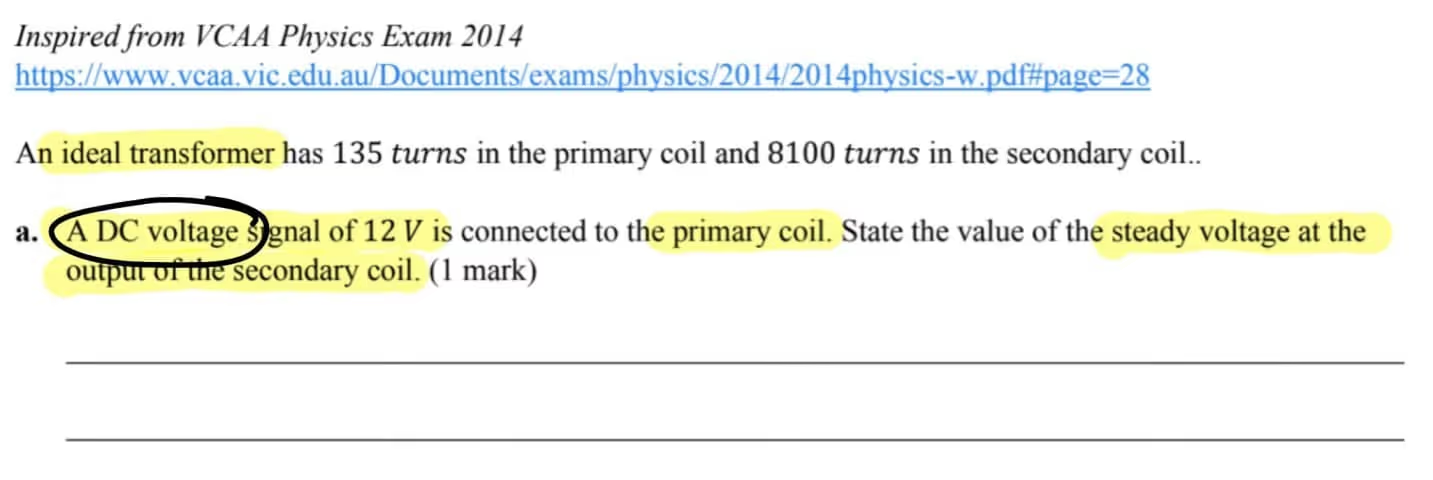
After underlining and reading the question AGAIN, it’s almost impossible to miss the DC voltage signal and how a transformer won’t operate with one. Remember, we’re coupling this with reading the question multiple times (above), so we’re assuming I underlined the keywords/phrases in the first read and have read it another one to two times after.

Here’s the assessor’s report from the 2014 VCAA Physics 3/4 Exam. 70% of the state missed the DC voltage (realistically 50% as 20% probably didn’t know what they were doing). If you’re gunning for the top scores, 1 mark can make the difference between a 49 raw and a 50 raw study score, so this is serious stuff.
Here’s another one:
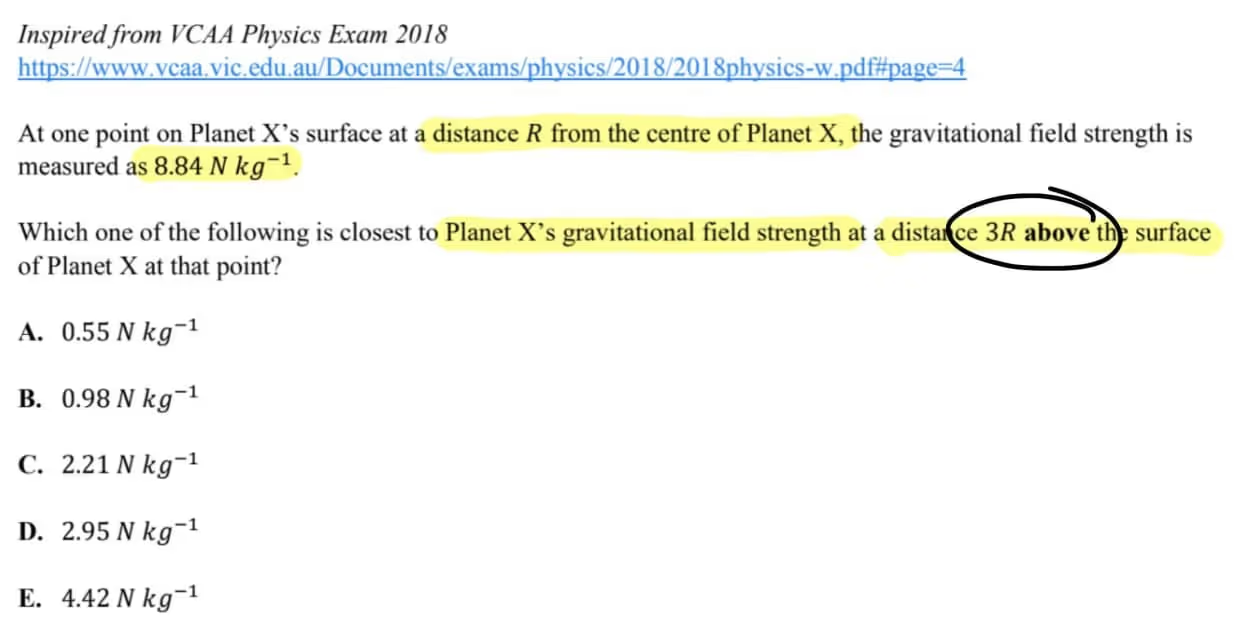
NOTE: We changed the number for our students.
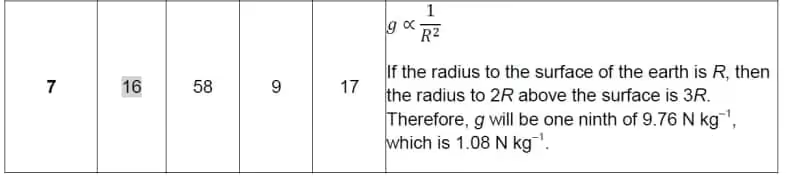
It’s astonishing to see close to 60% of the state misread the question from the 2018 VCAA Physics 3/4 Exam. How do I know they misread the question? Because to get B, you would have to divide the original gravitational field strength value by 3²as most students assumed the total distance was 3R. BUT the question says “above the surface”, so the total distance from the centre was R + 3R = 4R, so the original field strength was divided by 4², giving a value 16 times as small (rather than 9).
I highly recommend you circle or aggressively underline bolded words in an exam as usually, there are tricks in the question like above. In fact, I sat the VCAA 2018 exam, and I can confirm I noticed the trick in the question, and it was all because I read the question multiple times and severely underlined the word “above”, so it was blatantly obvious they were out to get me.
Sometimes, less is more, so adopting a habit as simple as highlighting and reading the question multiple times can help you secure the extra marks that push up your score.
If you’re interested in joining our VCE Physics Tutoring, click here to learn more and sign up for a FREE trial lesson!