
QTAC Applications Guide for Medical and Dental Entry (2027 Domestic Entry)

Last updated: 10 August 2026. Several Queensland universities, including Bond and Griffith, are expected to update their entry information between August and October 2026, and QTAC republishes its key dates through the same period. We review this guide after each update. Always confirm course codes, dates, fees and entry conditions on the official university and QTAC pages before you submit.
Overview
TL;DR
- QTAC is the main admission centre for almost every Queensland medical and dental course; JCU also needs a separate written application.
- UQ, CQU and USQ rank you on a selection rank, not raw ATAR, so the UCAT usually decides interview offers.
- JCU and Bond ignore the UCAT entirely; they run on ATAR plus a written application or a psychometric test.
- You get only six QTAC preferences but up to seventeen med and dent options, so ordering is a real strategic decision.
- Medicine and dentistry offers land in the January rounds, not the December round.
- Written for Year 12 and gap year domestic students aiming at QLD medicine or dentistry.
Preferencing in Queensland is more challenging than it looks. QTAC gives you six preferences, yet between medicine and dentistry, bonded and non-bonded places, and universities that have multiple campuses, there are around seventeen options worth considering. On top of that, the universities do not all have the same criteria: three of them never see your raw ATAR, two of them never look at your UCAT, and one will not consider you at all unless you also lodge a separate written application on its own website.
This guide lays out every Queensland medical and dental course: how each university selects, how much each component of your applications counts, strict deadlines, and how to order six preferences across seventeen options without leaving an offer on the table. The aim is that by the end you can build a preference list with a clear reason behind every decision.
Who this applies to
- Year 12 students in Queensland or interstate applying for QLD medicine or dentistry: this guide is written for you.
- Year 11 students planning ahead: all of it applies. Treat the timeline as a preview of your next year.
- Gap year and non-standard applicants: most courses accept you, and the relevant rule is noted under each university.
- Rural and First Nations applicants: every university runs its own access scheme; the equity section and each profile flag where to look.
- Postgraduate (graduate-entry) applicants: this guide covers school-leaver and provisional entry only, not the GAMSAT and GPA route.
What is QTAC, and why it matters for medicine and dentistry
The Queensland Tertiary Admissions Centre (QTAC) is the centralised body that processes applications to Queensland universities. Students anywhere in Australia apply through QTAC to study at institutions such as the University of Queensland, Griffith University and James Cook University. For aspiring medical and dental students, applying through QTAC is mandatory as most Queensland medical and dental schools accept applications only through QTAC and do not run a direct application of their own.
There is one exception. James Cook University requires both a QTAC application and a separate written application lodged directly with the university. If you miss the JCU portal, your QTAC preference alone does nothing.
UQ/CQU/USQ selection rank, and why it changes your strategy
UQ, CQU and USQ rank applicants differently from most other schools. They don't use your raw ATAR directly, rather they convert your ATAR into a selection rank and add adjustment points on top. Students studying the following Year 12 subjects are eligible to receive adjustment points: two points for Specialist Mathematics, two points for a language other than English, and one point for a recognised university subject. You can receive a maximum of 5 adjustment points across all schemes. Other circumstances can also earn adjustments, and UQ publishes the full set of admission schemes and adjustment rules on its website. These universities never see your raw ATAR; they see only the adjusted selection rank.
Because so many competitive applicants pick up these adjustments, a large share of them land on a selection rank of 99.95. With so many applicants sitting on this perfect rank, the ATAR can no longer separate them and that's where the UCAT comes in. At UQ, CQU and USQ the UCAT becomes the real differentiator. Your ATAR still has to clear the hurdle, but it is your UCAT that decides between who gets an offer and who doesn't.
Course by Course Guide
Which medical and dental courses apply through QTAC?
Every Queensland and interstate applicant can apply to the courses below through QTAC. Some institutions require additional steps, noted in each profile.
University of Queensland (UQ)
UQ offers a provisional-entry pathway to medicine and is structured with an undergraduate degree of your choice followed by the four-year Doctor of Medicine (MD), provided you finish the undergraduate degree in minimum time and achieve a GPA of at least 5.0.
UQ recently announced a new vertical dual pathway starting in 2027, allowing students to graduate from the MD in six years rather than seven through a two-year bachelor of medical science followed by the four-year MD. There are approximately 20 places available for domestic students. The main difference between this pathway and the seven year provisional-entry pathway is the subject prerequisites. The new six year pathway requires both English and Mathematical Methods, where the standard provisional pathway requires only English. Both of these programs require an interview in an MMI format, with 50% of interview places allocated to Queensland students. The UCAT is the only criteria used for interview offers, making it a very important component for aspiring UQ medical students.
UQ also offers a five-year undergraduate dentistry program. Unlike all other medical and dental programs, UQ dentistry looks at all 4 sections of the UCAT (includes Situational Judgement) and does not have an interview in its selection process.
Below are the weightings for the final offers rounds at UQ:
- Medicine: UCAT 25%, ATAR 25% (minimum 95), MMI Interview 50%
- Dentistry: UCAT 50% (including the Situational Judgement subtest) and ATAR 50% (minimum 99).
Central Queensland University (CQU)
CQU partners with UQ to deliver a provisional-entry pathway to medicine and is structured with a three year bachelor of medical science followed by the four-year Doctor of Medicine (MD). It's held at UQ's Rural Clinical Schools in Bundaberg and Rockhampton. The entry requirements are very similar to UQ, with the only exception being an additional subject prerequisite of either Biology, Chemistry or Physics alongside English and Mathematical Methods. CQU does also lean more heavily toward Queensland students and tends to need slightly lower scores than UQ.
University of Southern Queensland (USQ)
USQ also partners with UQ to deliver a provisional-entry pathway to medicine and is structured with a three year bachelor of biomedical sciences followed by the four-year Doctor of Medicine (MD). It's held at UQ's Rural Clinical School in Gatton and also follows similar entry requirements as both UQ and CQU, requiring only English and Maths prerequisites subjects. The one difference is a preference for students from the Darling Downs region when allocating the initial interview spots.
Griffith University
Griffith runs a six-year provisional medicine course split into a two year Bachelor of Medical Science followed by the four-year MD. Griffith primarily uses the ATAR as its selection criteria for applicants, using the UCAT only to separate applicants on the same ATAR with no interview. The Bachelor of Medical Science is taught at either the Nathan campus in Brisbane or the Gold Coast campus. There are roughly 30 places per location and a 5.0 GPA is required for progression into the MD.
Griffith adds a small adjustment for local applicants: +0.05 to the ATAR for Queensland students applying to Nathan, and +0.05 for Queensland and Northern NSW students applying to the Gold Coast. In recent years applicants have needed around 99.90, though Queensland students effectively need 99.85 once that adjustment is applied.
Griffith also runs a five-year provisional dentistry course split into a three-year Bachelor of Dental Health Science followed by a two-year Master of Dentistry. The Master of Dentistry is a full-fee place and approximately $75,500 per year is paid out of pocket for the last 2 years of the program.
Their selection criteria includes a competitive ATAR (a minimum of 90, though realistically higher), UCAT and an MMI interview, with the final offer consisting of 20% UCAT, 40% ATAR and 40% interview. The program runs at the Gold Coast campus only, with prerequisites of English and one of Methods, Biology, Chemistry or Physics.
University of the Sunshine Coast (USC)
USC offers a provisional pathway into the Griffith postgraduate medicine degree, with the three-year bachelor of medical science component taught at the Sunshine Coast campus followed by the four-year MD. A GPA requirement of 5.5 is required to transition into the MD which is slightly higher than other Queensland programs.
Entry requirements are very similar to Griffith with a 99.90+ ATAR required and the UCAT used as a second order differentiator between applicants. It is important to note that not all applicants with a 99.90 ATAR were made an offer due to the limited spots of around 20. Unlike Griffith, USC does not offer ATAR adjustment for local applicants.
James Cook University (JCU)
JCU's application process is quite unique compared to all other universities as it requires you to submit an application to QTAC and directly to the university via the JCU Application Portal.
JCU medicine offers a six-year undergraduate degree based in Townsville (the main campus) and Cairns (a secondary campus). Like Griffith and USC, it does not use the UCAT and looks at your predicted ATAR and your direct application to decide interview offers. Your school submits a Prediction of Academic Achievement form on your behalf, which is used for the first round of panel interviews in October. The second round of interviews in early January are selected based on your actual ATAR. The ATAR requirement usually sits around 97+, but JCU has a rural bias that makes metropolitan applicants typically need a very high ATAR, around 99.80 and above. Interviews are conducted online in a panel format, with around 170 places across the two campuses. JCU medicine also carries the most subject prerequisites: English, Mathematical Methods and Chemistry.
JCU dentistry is a five-year program in Cairns only, graduating with a Bachelor of Dental Surgery. Its selection criteria combines both the ATAR with a written application of several short responses to 4 questions (maximum 300 words per response) on your motivation for dentistry, your interest in rural and Indigenous oral health, and the experiences behind your decision, supported by reference letters (maximum of 3 can be submitted) from people who know you, such as community leaders, work or volunteering supervisors, or teachers. The written application is heavily weighted and a 99+ ATAR is recommended for metropolitan applicants due to the rural bias. There is no interview required and roughly 100 places are available.
Bond University
The 96.75 hurdle is a 2025 entry figure. Bond has confirmed 96.75 as the official hurdle ATAR for 2025 entry but has not published a confirmed figure for 2026 entry. Treat the number below as indicative, and check Bond's admissions page for the current hurdle before you apply.
Bond medicine has the shortest undergraduate medical degree in Australia of four-years-and-eight-months. Students graduate with a Bachelor of Medical Studies and Doctor of Medicine. Like Griffith and JCU, it does not use the UCAT in its selection process, rather it sets a hurdle ATAR, confirmed at 96.75 for 2025 entry, and every applicant above the hurdle is invited to the psychometric test. The ATAR is no longer used after this stage.
The psychometric test, held from late February to early March, is an emotional intelligence assessment of how an applicant recognises emotions and responds to situations. Scores from the psychometric test last for 2 years, meaning if you re-apply to Bond in the following year, you cannot resit the test and must use your existing score.
The final stage is an online MMI in mid-March, and the final offer is based entirely on the interview performance, with offers released in late March. Because the degree is shorter, intakes start in May or September, with around 180 total places for both intakes.
Bond medicine's timeline also runs differently to other universities. Applications open through QTAC in early-to-mid January (5th January 2027 for non-existing QTAC applications and 14th January 2027 for existing QTAC applications) rather than by the late-September deadline that applies elsewhere. Bond is a private university, so its medical program isn't Commonwealth supported meaning the fees are substantial. In 2026, the program cost $33,610 per semester across 14 semesters with government FEE-HELP support capped at $182,172. Once that loan is used up, the remaining fees are paid out of pocket which works out to roughly $20,598 each semester (please note that these figures are subject to change).
Queensland University of Technology (QUT), from 2028
QUT has announced a five-year medical degree starting in 2028, with roughly 48 places a year. Details on the admission process are limited, but at this stage the UCAT will be required. Its most notable feature is a part-time study option, which would be the first of its kind for medicine in Australia.
QTAC Codes
When preferencing on QTAC, it is vital to understand that for some universities there are more than one course code for the same degree. These course codes come from one of two things: the place type or the campus.
Place type: CSP vs BMP vs FFP
At UQ, CQU and USQ, every medicine place is either a Commonwealth Supported Place (CSP) or a Bonded Medical Program (BMP) place.
- CSP is the standard government-subsidised place. You pay the normal student contribution through HECS-HELP, with no obligations attached once you graduate.
- BMP is the same degree, taught alongside CSP students, but you sign a Deed of Agreement committing to a Return of Service Obligation, working in a regional or rural area of workforce shortage for three years within 18 years post-graduation. Because fewer applicants want that obligation, BMP places sometimes have a slightly lower admission threshold than CSP.
- FFP stands for Full Fee Paying. It can apply to an entire degree from year one, where the course was never government-subsidised to begin with, or it can apply partway through a degree, where an earlier CSP component transitions into a full-fee component once you progress into a later, more specialised stage. Either way, FFP cost cannot be deferred through HECS-HELP, and there is no Return of Service Obligation attached, since the higher fee replaces the bonding arrangement rather than sitting alongside it.
QTAC lists these different place types as separate courses with separate codes, so a UQ medicine applicant who wants to be considered for both BMP and CSP needs to apply to both courses separately.
University-specific data matrix
Below is a side-by-side view of how each Queensland school selects with cut-offs. Please note these figures are approximates based off recent years and are subject to change year to year.
Campus
Several universities run the same course at more than one campus, and each campus gets its own course code too. For instance, JCU medicine occurs at both Townsville or Cairns. Griffith's medicine feeder degree has 2 campuses as well: Gold Coast or Nathan. CQU's medicine pathway runs at Rockhampton or Bundaberg, and since CQU also splits CSP/BMP, that one university alone can give you four genuinely separate lines to consider.
The table below lists the course codes for every Queensland medicine/dentistry course and place type you can preference. Be sure to verify each one in QTAC Course Search before submitting, since codes change between cycles.
Timeline & Applying
The critical QTAC timeline for 2027 entry
The table below describes the timeline of your application, from when you start your QTAC application up until you receive an offer.
Step-by-step: setting up your QTAC application
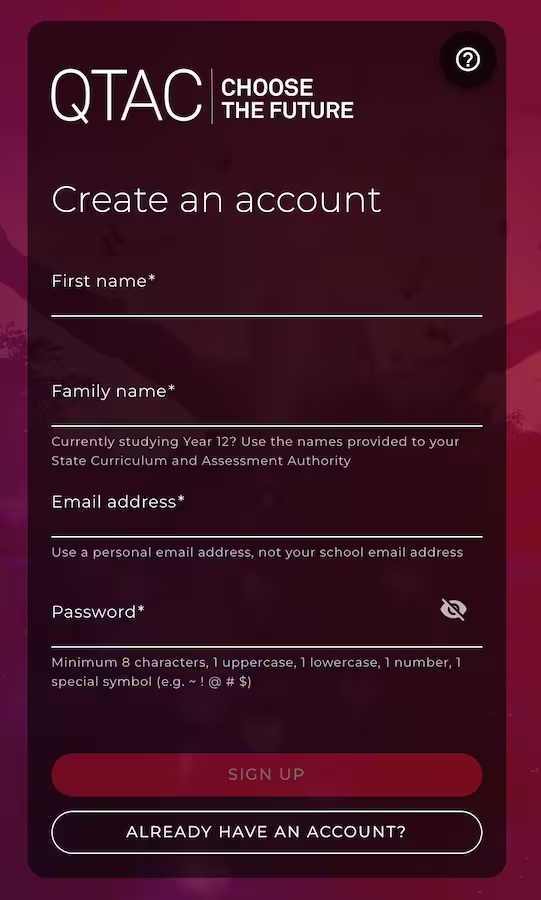
- Create your QTAC account. Make sure to enter your name exactly as your school records it, or QTAC may not match the data your school sends. Add your citizenship or visa details, your Unique Student Identifier (USI), and your contact and address details. Please ensure to use a personal email, not your school email address as this account will usually expire at the end of year 12.
- Add your history. Log in and enter your education history and your UCAT candidate details.
- Find your course codes. Use QTAC Course Search to locate each course code, then add it as a preference. You can find the course codes for all Queensland medicine/dentistry courses in the table above. Please make sure to verify the codes since they can change each year.
- Order, pay, submit. Use the arrows to move preferences up or down and the cross to remove one. Make sure to pay the application fee ($75 for current year 12 students and $128 for all other applicants) and submit by the 30 September deadline.
Application prices increase if you submit after 30 September.
Preferencing & Equity
Preferencing strategy
Queensland is the trickiest state to preference because you have six slots but including medicine and dentistry, bonded and non-bonded, and separate campuses, you have around seventeen possible options. Before ordering, work through five questions:
- Do you lean toward medicine or dentistry?
- Is your UCAT or your ATAR the stronger half of your profile?
- Does location matter, and where would you actually move to study?
- Does a bonded place change your decision?
- Do you want a backup course preferenced before the first offer round?
Those answers usually narrow the field quickly. If your UCAT is the stronger half, prioritise UQ, CQU and USQ, then choose between locations and between bonded and non-bonded. Bonded places often carry a slightly lower UCAT threshold, because fewer applicants want them.
How QTAC turns preferences into an offer
Understanding the mechanism removes most of the anxiety:
- At each offer round, every university tells QTAC whether you have earned a place in its course.
- QTAC then makes you a single offer: the highest course on your list that you have qualified for.
- Universities cannot see where you ranked them, so your order never affects your competitiveness.
- Preferencing has no bearing on interview offers either; those depend only on whether you meet each university's thresholds, and they are sent regardless of order.
Insider Insight: the JCU written-application trap
Students familiar with the TAC system often assume one application covers everything. However, both JCU medicine and dentistry requires a separate direct application on its application portal.
Preferencing JCU on QTAC does nothing on its own. You also have to lodge the JCU application and have your school send your predicted ATAR. The medicine direct application is brief (your details and schooling) whereas the dentistry written application is much more comprehensive, requiring written responses and reference letters.
Action: if JCU is anywhere on your list, diarise the portal as a second, independent deadline.
EAS: the Educational Access Scheme
The Educational Access Scheme (EAS) lets universities account for hardship or disadvantage that may have affected your ATAR, so they can assess your potential more fairly. It does not waive a course's minimum requirements. For example, UQ medicine's minimum of 95 stands regardless of any EAS adjustment. Queensland uses one centralised EAS application through QTAC, with supporting documentation, and each university then decides your adjustment under its own guidelines.
QTAC groups EAS into five categories, each needing its own level of evidence:
- Home environment and responsibilities
- Financial hardship
- School environment
- English language difficulty
- Personal illness or disability
Interstate and international applicants
Interstate applicants apply through QTAC in the same way as Queensland students, with two things to watch. JCU and several UQ-linked programs are biased toward Queensland or regional applicants, so a metropolitan interstate applicant generally needs a higher ATAR and UCAT. You can also hold a Queensland offer while waiting on another state: accepting a QTAC offer does not affect an offer through UAC, VTAC or another centre, so accept in the meantime and decide later.
International applicants follow a separate process with different tests and English-language requirements, and places are more limited. Confirm the specific requirements with each university's international admissions team before applying.
After the application
Change-of-preference windows
After 30 September, the only medical or dental courses you can add are Griffith and USC, up to the 7th of December. Bond runs on its own January timeline, separate from the September deadline. You can rearrange your existing preferences until the change-of-preference deadline published for each offer round, which for the first January round is 7 January 2027, and preference changes reopen once offers have been released. Once you remove a course you cannot add it back. Check QTAC's key dates page for the exact 2026 windows.
Responding to offers
QTAC offers you the highest preference you qualify for, and there is more than one round, so a first-round offer is not your last chance. Each offer gives you three options:
- Accept. Always accept a first-round offer, even one you do not ultimately want, so you are guaranteed a place. Accepting does not commit you to fees until the census date, usually a few weeks into the academic year. Watch the response window, often only three to four days. If you are waiting on an interstate offer, accept here in the meantime.
- Defer. Holding a place for a year is possible, but medical and dental schools are stricter about deferrals given how competitive they are. Confirm the policy before relying on it.
- Reject. The riskiest choice. If no later offer arrives, you cannot undo a rejection or fall back on that course.
The smart move across rounds is the conditional accept. If you receive, say, your second preference, accept it but move it to the bottom of your list, so you stay eligible for your higher preferences in later rounds. Many top-band applicants hold several offers and eventually release all but one, which frees places for students waiting on later rounds. Once you have accepted your final offer, enrol with the university directly.
How to stand out from the rest
Insider angle: what most applicants get wrong about Queensland preferencing
The common mistake is treating Queensland like a single ATAR race. It is not. The state runs two different selection logics at once, and which one you are facing depends entirely on which universities you preference.
At UQ, CQU and USQ, the ATAR is converted into a selection rank, and so many strong applicants reach 99.95 that the ATAR stops separating anyone at the top. There, the UCAT is what earns the interview, and the interview itself carries half the final decision at UQ. At Griffith and USC, the logic flips: the ATAR is king and the UCAT is only a tiebreaker. At JCU and Bond, the UCAT does not feature at all; JCU runs on predicted ATAR plus a direct online application, and Bond runs on a hurdle ATAR plus a psychometric test and interview. A student with a strong UCAT and a slightly softer ATAR is competitive in one half of the state and disadvantaged in the other, and the reverse is equally true.
This is also why bonded places deserve a second look. At UQ a bonded medicine place often clears at a slightly lower UCAT threshold than the non-bonded equivalent, simply because fewer applicants want it. Listing both as separate preferences costs nothing and can be the line between an offer and a near miss.
Insider data: Contour student offers, Queensland, 2026 cycle
Across Contour students in the 2026 cycle, Queensland medical and dental offers included: UQ 135, Griffith 69, JCU 53, USC 17, CQU 7, and USQ 4 (Contour MedPrep, 2026 cycle).
Nationally, Contour students received 867 med and dent offers across 500+ students that cycle.
These are offers received by Contour students, not university intake totals, cut-offs, or a prediction for any individual applicant.
The takeaway is practical: decide which half of the Queensland system your profile fits, build your six preferences around it, and use bonded and split-campus options to add lines rather than waste them.
Case study: ordering six preferences across seventeen options
Hannah is an illustrative composite, not a real student. Her scores and decisions reflect patterns we see across many Queensland applicants.
Archetype: Queensland, direct-entry, 89th percentile UCAT, 99.20 ATAR, MM1
Decision point: How to arrange her Queensland preferences to give herself the best shot at medicine
Key lesson: Preference the courses you actually want highest, and trust that a realistic option lower down still gets seen
Hannah finished Year 12 in Brisbane with a 99.20 ATAR and a UCAT in the 89th percentile. Her scores are on the borderline for most competitive Queensland medical schools however she is still set on medicine and has no interest in dentistry. What mattered most to her was staying close to home: she'd much rather study in Brisbane than move rural, even if a rural course meant a shorter degree.
When Hannah first sat down to build her QTAC application, her instinct was to put JCU as her first preference. She felt it gave her the best shot at an offer, since JCU doesn't look at the UCAT and would focus more on her strong ATAR instead. The problem is that JCU is a rural school in Townsville or Cairns, which is exactly what she doesn't want. Putting JCU first would be ranking a course she'd be reluctant to accept over the Brisbane-based courses she actually wants.
After attending a QTAC webinar run by her school, she realised that universities never see the order you put them in. QTAC simply works down your preferences and makes you an offer for the highest course you qualify for, so putting UQ or CQU above JCU doesn't reduce her chance of getting into JCU at all.
Once that clicked, she started rearranging her preferences around what she actually wanted. Since Hannah wants to stay in Brisbane, the only two courses that allow that are UQ CSP and BMP medicine. At first glance it may seem intuitive to use your first two preferences for these courses, however it is important to realise that you will only have four preferences left for around fifteen other possible courses. Rather than taking two spots for the same university and missing out putting another university down that she has a chance at getting into, Hannah decided to not include UQ CSP and put UQ BMP as her first preference. Bonded places usually have lower entry scores than the CSP equivalent, because fewer applicants are willing to take on the return-of-service commitment, so for a borderline applicant like Hannah, BMP is a far smarter use of that top slot than CSP.
The same logic applies at CQU, where the bonded pathway has lower entry requirements compared to the CSP pathway. Preferencing her application with CSP courses she was less likely to get an offer for, or with courses like Griffith and USQ which needs around 99.85+ ATAR alone would have wasted her limited slots on courses that she was unlikely to receive and reduce her chances of receiving any offer at all.
A key lesson to be learnt here is that even though you should order by genuine preference, the courses you pick should still be realistic to gain admission since there's little point using a slot on a course that you already know you won't get into.
From here on her preferences followed the same logic, ordered by genuine preference among courses she could realistically reach:
- UQ BMP medicine - her top choice, Brisbane-based, with the lower bonded entry score giving her a genuine shot.
- CQU BMP (Bundaberg) - a UQ-partnered pathway that leans toward Queensland applicants, and again the bonded place over the CSP one for the better chance.
- CQU BMP (Rockhampton) - the same pathway at the second CQU location, she ranked Bundaberg above Rockhampton simply on where she'd rather live.
- USQ BMP medicine - another UQ-partnered rural clinical pathway favouring Queensland students, kept on as a further realistic shot.
- JCU (Townsville) - still on the list as a genuine option, but ranked where it belonged for her: a course she'd accept only if nothing above came through. Because order is invisible to the universities, sitting fifth didn't reduce her chances there at all.
- UQ Physiotherapy - a course she'd be content to start if no medical offer came, so a missed year wouldn't leave her with nothing.
The lesson from Hannah's situation is that preferencing a course higher doesn't improve your chances of an offer. Preference the courses you genuinely want in the order you want them and make sure they all are realistic options. Had she led with JCU, she might have ended up at JCU Townsville with a UQ medicine offer below that is left untouched.
The details most applicants miss
- UQ, CQU and USQ never see your raw ATAR. They look entirely from the selection rank, so a student who picks up the full five adjustment points is competing at 99.95 with a student who got a raw 99.95. Plan your Year 12 subjects with that in mind, and treat the UCAT as the real separator.
- Bonded and non-bonded are two separate preferences. Listing both, with bonded just below non-bonded, adds a realistic extra shot at an offer, often at a slightly lower UCAT threshold.
- JCU has two campuses and a second application. Townsville and Cairns are separate QTAC preferences, your school must submit the Prediction of Academic Achievement form, and interviews run in two rounds: October on predicted ATAR, then early January on your actual ATAR. The direct application via the JCU Application portal is the part applicants most often forget.
- Bond runs on its own January timeline. You cannot preference Bond by the September deadline. Applications open through QTAC on 5 January 2027 and close on 19 January, a window that spans the first offer round.
- Griffith dentistry is a full-fee place for the last 2 years. The Master of Dentistry years are full-fee, at roughly $75,500 per year, which is around $151,000 over the two postgraduate years and cannot be deferred the way a Commonwealth-supported place can. Factor it into your decision.
- USC requires a higher GPA to progress. Its provisional pathway requires a 5.5 GPA through the undergraduate years, compared to the 5.0 GPA requirement for both CQU and UQ. It is a small difference on paper that matters across three years of study.
- Change of preference is restricted for med and dent. After 30 September, only Griffith and USC can be added among medical and dental courses, and a course you remove cannot be re-added. Order carefully before the deadline rather than relying on later edits.
Frequently asked questions
Conclusion and next steps
Although Queensland is viewed as the hardest TAC to preference due to the seventeen medicine and dentistry courses to pick from with only six preferences, understanding selection logic makes the six-preference puzzle manageable.
- Most Queensland med and dent courses run through QTAC; JCU and Bond add their own steps and timelines.
- UQ, CQU and USQ rank on a selection rank where the UCAT decides interviews; Griffith, USC, JCU and Bond do not weigh the UCAT the same way.
- With six slots for up to seventeen options, order by your genuine preference and use bonded places and multiple campus universities to widen your chances.
Action points:
- Map your profile: understand which universities you have a realistic shot at gaining admission in and ranking these based on where you would prefer to study.
- Build your six preferences before 30 September, listing non-bonded above bonded and adding JCU campuses as separate lines.
- If JCU is on your list, lodge its separate application and confirm your school will send your predicted ATAR.
- Verify every course code, fee and date in QTAC Course Search and on QTAC's key dates page before you submit.